Aerojet General X-8
Overview
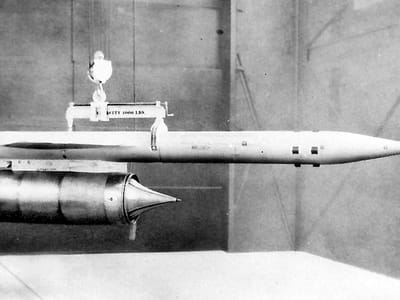
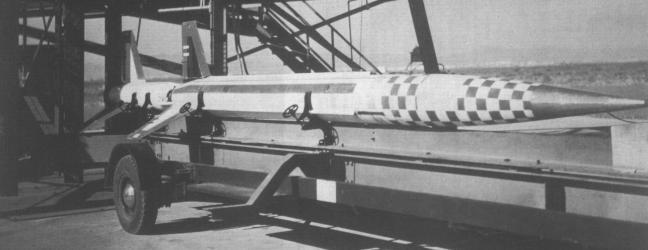
The Aerojet General X-8 was an unguided, spin-stabilized sounding rocket designed to launch a 150 lb (68 kg) payload to 200,000 feet (61.0 km). The X-8 was a version of the prolific Aerobee rocket family. Towards the end of World War II, the US Army and the California Institute of Technology's Jet Propulsion Laboratory had developed a meteorological sounding rocket, the WAC Corporal. The U.S. Army had also captured enough parts to assemble perhaps 100 German V-2 guided missiles. The Army determined that its Project Hermes would be extended to assemble and launch a number of the V-2s for military, technological and scientific purposes. Many of the V-2 components were damaged or useless. Thus the initial intent of the Army was to launch only 20 missiles. The Army was to make space available on the V-2s for upper atmosphere research. Due to the limited number of V-2s, originally planned design of several competing sounding rockets continued. Jet Propulsion Laboratory initially favored its WAC Corporal despite its inadequacy. The competing rockets were the Applied Physics Laboratory's Aerobee and the Naval Research Laboratory's Neptune (Viking). The Army determined that it would refurbish and manufacture components as necessary to launch many more V-2s than originally intended, making most available for science. The Aerobee was developed in response to the need for a sounding rocket to replace the dwindling numbers of V-2s. Design and initial development of the Aerobee occurred between June 1946 and November 1947. The first Aerobees, the Navy RTV-N-8a1 and Army Signal Corps XASR-SC-1, used the Aerojet XASR-1 2,600 lbf (12 kN) thrust air-pressurized engine. Aerojet's XASR-1 was developed from the 1,500 lbf (7 kN) thrust WAC-1 engine of the WAC Corporal sounding rocket. The USAF RTV-A-1 (X-8), Navy RTV-N-10 and Army XASR-SC-2s used the Aerojet XASR-2 2,600 lbf (12 kN) thrust helium pressurized engine. In 1949 the Air Force instigated the development of a more powerful Aerojet engine to replace the 2,600 lb.-thrust XASR-2. This was the 4,000 lbf (18 kN) thrust helium-pressurized AJ 10-25. The USAF X-8A (RTV-A-1a) and USN RTV-N-10a used the seminal Aerojet AJ-10-25 (Air Force) or AJ-10-24 (Navy). The Army Air Force's Air Research and Development Command, needing its own research programs, initiated Project MX-1011 and ordered 33 AJ-10-25 powered Aerobees as RTV-A-1s. That designation was later changed to X-8. Ultimately the rocket was renamed again as RM-84. The number of X-8s flown came to 60 including 28 X-8s (RTV-A-1), 30 X-8As (RTVM-A-1a), 1 X-8B (RTV-A-1b) with a 2,600 lbf (12 kN) thrust XASR-2 chemically pressurized engine, and 1 X-8C (RTV-A-1c) with a 4,000 lbf (18 kN) thrust AJ 10-25s helium pressurized engine with no booster. The three X-8D with 4,000 lbf (18 kN) thrust AJ 10-25, were never flown. A Navy experimental launch of a stretched Aerobee, the RTV-N-10b resulted in both services requesting improved Aerobees, known generically as Aerobee-Hi.